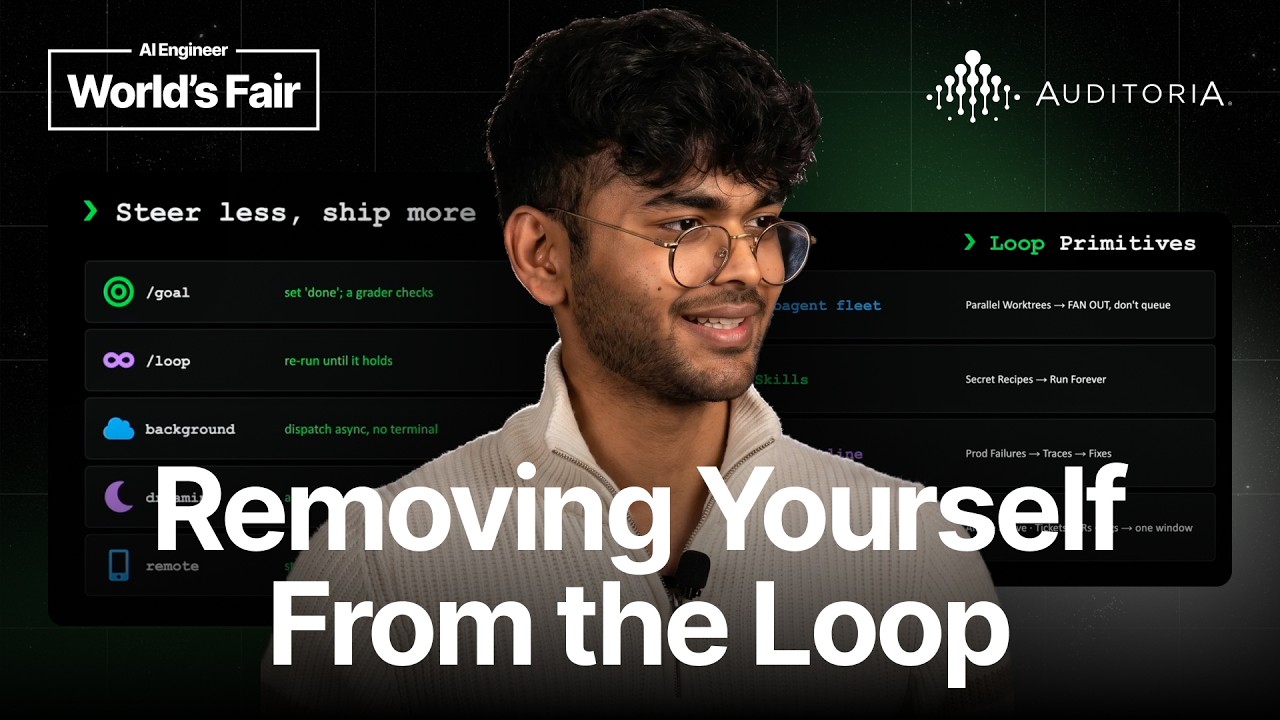
No clickbait detected — the title and thumbnail deliver what they promise.
AI Opinion
Emani makes a compelling case that developer velocity, rather than current AI model limitations, represents the most significant bottleneck in agent-based software development—a perspective supported by observed pressures to resolve production issues quickly. However, his claim that agents can reduce human intervention to only initial task definition and final validation feels overly optimistic, resting on an assumption of seamless "work tree" implementation and readily codified organizational “skills.” Listeners should critically evaluate the resource demands for running numerous independent agent sub-processes, as well as consider how effectively complex domain knowledge can be translated into actionable instructions for automated systems.
Avatars are AI rewrites of the same facts — style changes, not substance.
Summary
Ramana Siddanth Emani discusses a bottleneck in agent-based software development, arguing that developer velocity, not just model capability, is currently the primary limiting factor. He introduces "work trees" as a method for enabling parallel task execution and preventing conflicts during development. A key concept is defining “skills” to codify an organization’s domain expertise and ensure consistent application of best practices by agents in resolving production issues. The speaker envisions agent automation handling most steps within the software development lifecycle, significantly reducing human intervention to primarily initial task definition and final validation. While model capabilities are increasing rapidly, and production bug resolution is a constant need, the extent to which agents can fully automate the process and the resources required for operation remain areas needing further investigation.
Avatars are AI rewrites of the same facts — style changes, not substance.
Key Points
The Bottleneck Isn't Model Capability, It's Developer Velocity
Siddhant emphasizes that while model capabilities are increasing exponentially, the limiting factor in production agent development is developer velocity. He argues that developers spend significant time automating their workflows and creating efficient loops to keep pace with these advancements. This highlights a shift in focus from simply building better models to improving the speed and efficiency of the development process itself.
Work Trees Enable Parallel Task Execution
The concept of 'work trees' is introduced as isolated folders where agents generate code, allowing for parallel execution of tasks. This design prevents conflicts and improves efficiency by enabling multiple sub-agents to work independently on different aspects of a project within these dedicated environments. The speaker suggests this approach is crucial for handling complex production issues.
Skills Represent Organization's Domain Expertise
Skills are described as an organization’s 'secret recipes,' representing codified knowledge and best practices. By providing agents with these skills, they can consistently apply the correct workflows to resolve production bugs, ensuring adherence to established standards and reducing errors. This promotes consistency and efficiency in agent-driven problem solving.
Agent Automation Can Reduce Human Intervention
The speaker proposes that agents can automate most steps of the software development lifecycle, from parsing requirements and root cause analysis to implementing fixes, building Docker images, and deploying to environments. He suggests human intervention is primarily needed for initial task definition and final validation after deployment, significantly reducing manual effort.
Chapters
Claims & Fact Check
Production bugs are very high and production guards built by the hour.
The model capability increases very exponentially.
You can have 50 active sub-agents working independently on different tasks with a MacBook.
The human is only required at steps 1 and 9 of the development process.
Was this digest good?
More from AI Engineer
Teaching AI to Find Real Vulnerabilities — David Brumley, Bugcrowd
Aug 1, 2026
Rethinking Environments for Long-Horizon Work — Rayan Garg, Theta Software
Aug 1, 2026
What's Next After RLHF? — Diogo Almeida, TypeSafe AI
Jul 31, 2026
Data Quality Is the Compute Multiplier — Ari Morcos, DatologyAI
Jul 31, 2026
Digest any single YouTube video — free.
3 free digests — no card, no sign-up wall.
Or just swap the domain of any YouTube link → instant digest