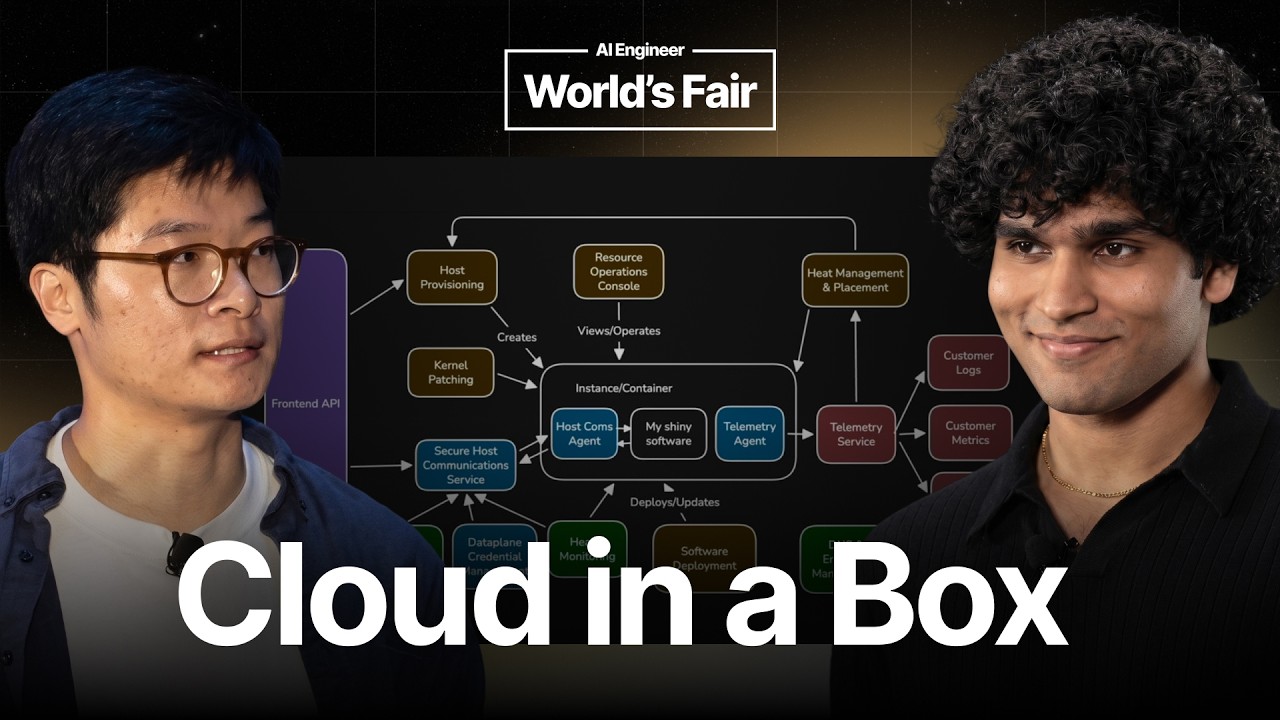
No clickbait detected — the title and thumbnail deliver what they promise.
AI Opinion
The episode most convincingly argues that current AI agent benchmarks for software engineering are overly simplistic, failing to account for the multifaceted realities of production systems—a point underscored by Modal’s focus on reliable infrastructure. While Wang's assertion that increased high-quality data consistently improves model capability is plausible, it lacks specific evidence and might be an oversimplification given potential confounding factors. Listeners should consider how Emulated's simulated environments represent the full spectrum of real-world software engineering complexity, particularly regarding nuanced organizational dynamics and unpredictable user behavior.
Avatars are AI rewrites of the same facts — style changes, not substance.
Summary
Joseph Wang, founder of Emulated and CTO of Modal, discusses the critical role of data in developing reliable AI agents for software engineering tasks. Current benchmarks inadequately assess agent capabilities by primarily evaluating code generation within limited scenarios, overlooking crucial aspects like customer interaction, performance testing, and infrastructure management. Emulated addresses this gap by simulating complete software engineering workflows within containerized environments that incorporate realistic operational complexities such as network failures, data corruption, and organizational contexts. Wang emphasizes that production systems involve far more than just source code, including elements like deployment processes, hardware migrations, and customer feedback. Ultimately, user priorities at Modal center around reliable, low-latency GPU sandboxes, highlighting the need for robust infrastructure and preventing training interruptions.
Avatars are AI rewrites of the same facts — style changes, not substance.
Key Points
The Importance of Data for AI Agent Reliability
Joseph Wang emphasizes that the performance of AI models is intrinsically linked to the quality and quantity of data they are trained on, stating 'Models typically are only as good as the data is.' He highlights that model capabilities have never regressed when high-quality data is introduced, suggesting a direct correlation between data gaps and limitations in agent performance.
Current Benchmarks Miss Crucial Aspects of Software Engineering
The current benchmarks like SweBench Pro, Terminal Bench, Frontier Code, and Deep Sweep primarily focus on code generation within a limited scope. These tests only assess the agent's ability to produce a few thousand lines of code over 50-100 turns, neglecting essential aspects of software engineering such as customer interaction, performance testing, and infrastructure management that are crucial for real-world applications.
Emulated's Approach: Simulating Full Software Engineering Contexts
Emulated is addressing the data gap by creating containerized environments that simulate complete software engineering workflows. These simulated environments incorporate organizational contexts like projects and incidents, customer conversations, network failures, data corruption, and clock skew – elements typically absent in standard benchmarks. This allows agents to learn from a more realistic and complex operational landscape.
The Complexity of Production Systems Extends Beyond Code
Joseph Wang illustrates that the complexity of production systems extends far beyond just the source code. He points to elements like tickets, postmortems, customer feedback, deployment systems, hardware migrations, failing nodes, and stale deprecated nodes as critical components that agents must understand and reason through in order to operate effectively within a real-world infrastructure.
User Priorities at Modal
Joseph Wang highlights that users of platforms like Modal prioritize specific features, namely GPU sandboxes with low latency and cost. He emphasizes the importance of preventing training runs from failing mid-process, indicating a focus on reliability and efficiency for developers. This user-centric approach shapes the problem statement and guides development efforts within Modal.
Chapters
Claims & Fact Check
When something like DynamoDB goes down, so does US East 1 and half the internet.
Model capability has never regressed whenever you introduce more high-quality data.
We've taken software engineering companies and we've put them into containerized environments.
Was this digest good?
More from AI Engineer

Teaching AI to Find Real Vulnerabilities — David Brumley, Bugcrowd
Aug 1, 2026

Rethinking Environments for Long-Horizon Work — Rayan Garg, Theta Software
Aug 1, 2026
What's Next After RLHF? — Diogo Almeida, TypeSafe AI
Jul 31, 2026
Data Quality Is the Compute Multiplier — Ari Morcos, DatologyAI
Jul 31, 2026
Digest any single YouTube video — free.
3 free digests — no card, no sign-up wall.
Or just swap the domain of any YouTube link → instant digest