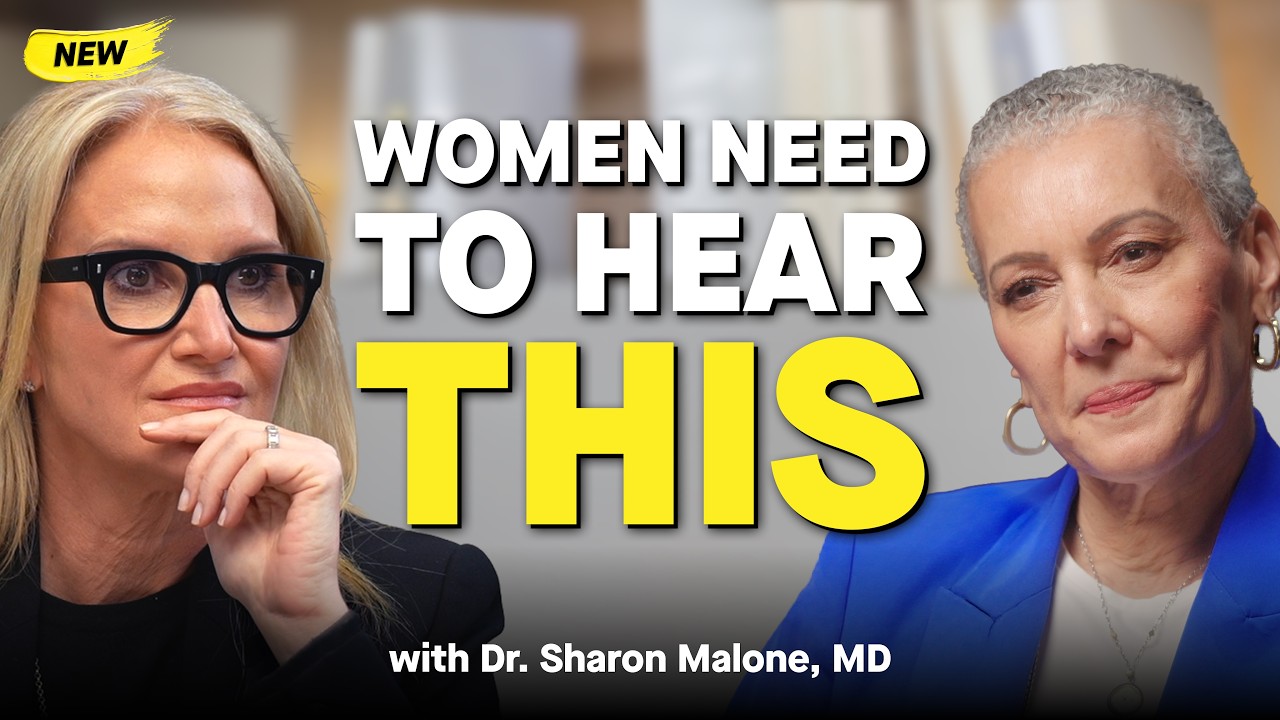
No clickbait detected — the title and thumbnail deliver what they promise.
AI Opinion
The episode convincingly argues that women's health should be viewed as a continuous hormonal story, effectively linking fertility decline, perimenopause, and menopause as interconnected stages, and it provides strong, verified evidence that male factor infertility is involved in up to 50% of cases and that vaginal estrogen is a local, not systemic, treatment. However, its claims rest on weaker ground when asserting that Black women have twice the risk of dementia (marked as needing further research) and that women lose 30% of skin collagen in the first five years of menopause (also unverified), while the statement that estrogen is the only medication preventing osteoporosis is only partially accurate, as other drugs like bisphosphonates exist for that purpose. A thoughtful viewer should double-check the specific statistics on racial disparities in dementia risk and the precise timeline of collagen loss, and keep in mind that while hormone therapy is the most effective FDA-approved treatment for hot flashes, the episode’s framing of estrogen as uniquely preventive for osteoporosis requires nuance.
Voices are AI rewrites of the same facts — style changes, not substance.
Summary
Dr. Sharon Malone frames women's health as a continuous hormonal story from puberty through menopause, emphasizing that understanding this continuum is key to managing health at every stage. A major theme is that infertility is not solely a female issue, as male factor infertility is involved in up to 50% of cases. The episode thoroughly explores menopause, detailing that estrogen depletion triggers a 30% loss of skin collagen, muscle and bone loss, and a redistribution of fat to the midsection. Vaginal estrogen is clarified as a local treatment for genitourinary symptoms, not systemic issues like hot flashes. Dr. Malone stresses that severe hot flashes can be a marker for future cardiac risk and that estrogen therapy is the most effective FDA-approved treatment for these symptoms, as well as the only medication with an FDA indication for osteoporosis prevention. On fertility, she notes that peak fertility is in the late teens and 20s, with a significant decline after 35, and that family history of early menopause is a critical signal. The discussion on birth control debunks the reliability of natural methods, confirms that pills increase blood clot risk less than pregnancy, and advises that a bad reaction to one formulation does not rule out all others. The episode also highlights the underdiagnosis of endometriosis, with an average diagnostic delay of 7 to 9 years, and points to racial disparities, noting that Black women experience longer perimenopause and have a higher risk of dementia, with chronic stress identified as a key contributing factor.
Voices are AI rewrites of the same facts — style changes, not substance.
Key Points
Summary, Key Points and AI Opinion are shown in the selected voice. Claims & fact-checks, chapter names and clickbait checks always show in the neutral voice.
Infertility Often Involves Male Factor
Dr. Malone highlights that infertility is not just a female problem—upwards of 50% of infertility cases involve male factor infertility. This challenges the common assumption that fertility issues are solely the woman's responsibility and underscores the need for couples to evaluate both partners.
Early Menopause in Family Signals Earlier Perimenopause
If a woman's mother experienced early menopause (e.g., at age 42), her daughter may enter perimenopause in her early 30s. This means fertility can decline sooner than expected, making it crucial for women to know their family history and plan accordingly.
Severe Hot Flashes May Indicate Cardiac Risk
Dr. Malone warns that women with more severe and frequent hot flashes may be at higher risk for impending cardiac issues. She stresses that misery should not be accepted as normal, and the most effective treatment for menopausal symptoms is hormone therapy, particularly estrogen. Many women regret not starting treatment sooner.
Women's Health Is a Continuous Hormonal Story
Dr. Sharon Malone explains that from puberty through reproductive years to perimenopause and menopause, women experience a continuous hormonal story. Understanding this continuum allows women to better manage their health and craft a better outcome at every stage. She emphasizes that hormonal changes affect every part of the body and are not disconnected episodes.
Many birth control pill options exist; a bad reaction to one does not mean all are unsuitable
Dr. Malone emphasizes that there are about 20 different birth control pill formulations, and women may react differently to different progestins. She advises against dismissing all pills based on a single negative experience, noting that lower doses and newer formulations make them more tolerable today.
Natural birth control is unreliable and not fertility-preserving
Dr. Malone explains that modern 'natural' birth control is essentially a modified rhythm method, which is historically unreliable. She notes that cycle tracking only works for women with extremely regular cycles, and that temperature rises after ovulation, making it too late to prevent pregnancy. She also debunks the myth that natural methods preserve fertility, stating that birth control pills do not harm long-term fertility.
Birth control pills are safer than pregnancy
Dr. Malone states that while birth control pills increase blood clot risk by 2–3 times, pregnancy increases it sixfold. She argues that the relative safety of birth control pills is far better than the health risks of pregnancy, and that women should choose the timing of pregnancy to protect their health and life goals.
Ovulation tracking is better for conception than contraception
Dr. Malone explains that ovulation predictor sticks are more useful for women trying to conceive than for those trying to avoid pregnancy. She adds that sperm can survive up to 72 hours, making the timing of natural methods even more precarious.
Endometriosis: Underdiagnosis and Diagnostic Delay
Endometriosis causes chronic inflammation and scarring when endometrial-like tissue grows outside the uterus, leading to pain, infertility, and organ-specific symptoms. The average diagnostic delay is 7 to 9 years because women often normalize painful periods and are treated by specialists for individual symptoms (e.g., GI or urology) without recognizing the underlying condition. Definitive diagnosis requires laparoscopy, as small lesions are often invisible on ultrasound or CT scans.
Fertility Decline: Age and Egg Quality
Peak fertility occurs in the late teens through the 20s, with a gradual decline starting around age 35–36 and accelerating in the early 40s. By age 40, the chance of conceiving is significantly lower than at age 20. The decline is driven not only by egg quantity but also by egg quality, as each egg has an intrinsic 'expiration date' influenced by genetics and environment. Family history—such as mother's age at last pregnancy or history of infertility—provides critical data for planning.
Egg Freezing: Timing and Practical Considerations
Freezing eggs does not alter their biological expiration date. The best yield for egg retrieval is in the 20s, but many women who freeze eggs in their 20s may never use them if they conceive naturally later. The decision involves balancing optimal egg quality against the likelihood of actually returning for those eggs, given the high cost and life trajectory.
Hot flashes as harbingers of chronic disease
Dr. Malone explains that hot flashes are not benign; they often signal future health issues like cardiovascular disease. Women with more severe and frequent hot flashes have higher risks for heart problems, hypertension, and type 2 diabetes. The connection is partly due to disrupted sleep from night sweats, which leads to chronic fatigue, reduced physical activity, and metabolic changes. Black women experience more severe, longer-lasting hot flashes starting earlier, partly due to chronic stress from discrimination and microaggressions.
Racial disparities in menopause symptoms and dementia risk
Dr. Malone notes that perimenopause lasts 4–10 years, but for African-American women it is closer to 10 years. Black women have twice the risk of dementia compared to white women, a fact she discovered while writing her book. Chronic stress is identified as a major factor accelerating aging and increasing risks for Alzheimer's, cancer, and weight gain. The host connects this to Dr. Gabor Maté's theory linking chronic stress and microtraumas to autoimmune disease rises.
Hot flashes disrupt sleep and cascade into health risks
The transcript details how night sweats from hot flashes cause chronic sleep disruption, which is a known risk factor for hypertension, type 2 diabetes, and cardiovascular disease. Dr. Malone explains that fatigue from poor sleep reduces motivation for exercise, leading to a sedentary lifestyle that further increases heart disease risk. She emphasizes that hot flashes are often the inciting event for a cascade of unhealthy behaviors and metabolic changes.
Hormone therapy as the most effective treatment for hot flashes
Dr. Malone states that hormone therapy, specifically estrogen, is the most FDA-approved effective treatment for vasomotor symptoms (hot flashes). She criticizes the cultural norm of suffering silently and using portable fans, urging women to seek treatment. She acknowledges that fear and misinformation about hormones keep many women from using this therapy, noting that similar misinformation affects birth control use in younger women.
Vaginal Estrogen Is Local, Not Systemic
Topical or vaginal estrogen is applied locally to treat Genitourinary Syndrome of Menopause (GSM), which includes vaginal dryness, painful sex, urinary frequency, urgency, and frequent UTIs. It stays where it is applied and does not enter the bloodstream, so it will not relieve hot flashes or sleep disturbances. Even women on systemic hormone therapy may still need additional vaginal estrogen for these local symptoms.
Menopause Causes Collagen Loss and Skin Changes
In the first five years of menopause, estrogen depletion leads to a 30% loss of collagen in the skin. The skin has estrogen receptors, so topical estrogen can increase hydration and collagen formation locally. However, this local application is insufficient to treat systemic symptoms like hot flashes.
Menopause Triggers Muscle Loss, Bone Loss, and Fat Redistribution
Estrogen affects muscles, bones, and skin, so menopause initiates a cycle of muscle and bone loss that accelerates after the final menstrual period. Even if weight remains stable, body composition shifts: fat redistributes to the midsection, muscle mass declines, and bone density decreases. This combination increases the risk of osteoporosis and fractures, especially if a woman starts with lower bone density.
Estrogen Therapy Is the Only FDA-Approved Medication for Osteoporosis Prevention
The estrogen component of hormone replacement therapy has an FDA indication for the prevention of osteoporosis. No other medication has this preventive indication. However, bone density at menopause depends on genetics, childhood calcium intake, and lifelong weight-bearing exercise. Once bone is lost, it is very difficult to regain; weight training can slow further loss but rarely restores original density.
Chapters
Claims & Fact Check
Upwards of 50% of infertility cases sometimes is male factor infertility.
?UnverifiedWomen who have more severe hot flashes and more frequent hot flashes, sometimes it is a marker for impending cardiac issues.
?UnverifiedThe most effective treatment is hormone or estrogen particularly for the symptoms of menopause.
?UnverifiedBirth control pills increase blood clot risk by 2–3 times, but pregnancy increases it sixfold.
?UnverifiedNatural birth control methods are unreliable, especially for women with irregular cycles.
?UnverifiedBasal body temperature rises after ovulation, so it cannot prevent pregnancy from sex that occurred before the temperature spike.
?UnverifiedThe diagnostic delay for endometriosis is 7 to 9 years.
✓Well-supportedEndometriosis lesions are often too small to be seen on ultrasound or CT scans.
±Partially supportedPeak fertility is in the late teens through the 20s, and by age 40 the likelihood of conceiving is much lower than at age 20.
?UnverifiedWomen who have more severe and frequent hot flashes have a higher risk for cardiovascular disease.
?UnverifiedBlack women have twice the risk of dementia than white women.
?UnverifiedHormone therapy (estrogen) is the most effective FDA-approved treatment for hot flashes.
?UnverifiedIn the first 5 years of menopause, women lose 30% of their skin collagen.
?UnverifiedEstrogen is the only medication that prevents osteoporosis.
?UnverifiedOnce bone is lost, you very rarely get back to where you started.
?UnverifiedMore from The Mel Robbins Podcast

The Manipulation Expert: 4 Hidden Signs You’re Dealing With a Toxic Person
Jul 20, 2026

How to Increase Your Emotional Intelligence & Never Get Angry or Bothered by Anyone
Jul 16, 2026

The Happiness Expert: How to Find Your Purpose & Live a Meaningful Life
Jul 13, 2026

How to Build a Better Future: 2 Simple Questions That Uplevel Your Life Immediately
Jul 11, 2026
Digest any single YouTube video — free.
3 free digests — no card, no sign-up wall.
Or just swap the domain of any YouTube link → instant digest