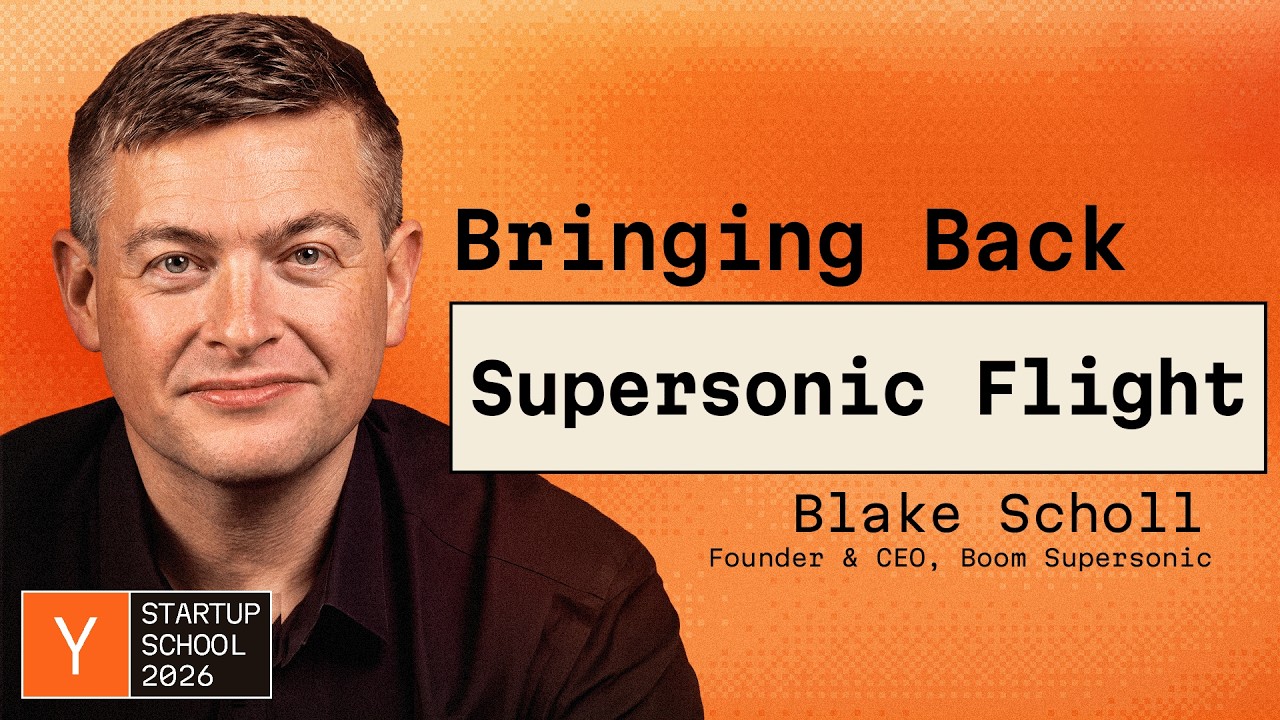
No clickbait detected — the title and thumbnail deliver what they promise.
AI Opinion
Scholl convincingly argues that aviation innovation has stagnated and presents Boom Supersonic’s approach—leveraging rapid design tools, in-house manufacturing, and novel financing—as a path toward revitalization, effectively illustrating the transformative power of air travel on globalization. However, claims regarding Boeing's current production status ("not even building new airplanes") and the speed of FAA approval (“just 90 minutes”) require further scrutiny; while Boom’s successes are noteworthy, characterizing them as universally swift might oversimplify a complex regulatory process. Listeners should also consider that Scholl’s perspective is inherently promotional, and independently verifying his assertions about competitor timelines and financial details would provide a more complete picture of the challenges facing supersonic aviation.
Voices are AI rewrites of the same facts — style changes, not substance.
Summary
Blake Scholl, founder of Boom Supersonic, discusses the stalled progress in aviation innovation since the optimistic era of 1969 and explores how his company aims to reignite that momentum. He highlights air travel's transformative impact on globalization, citing examples like Nike’s origins and The Beatles’ global tours. Boom’s approach involves proprietary tools like Bladeunner for rapid design iteration, in-house manufacturing to accelerate prototyping, and a novel financing strategy utilizing adapted engine designs as “Superpower” turbines. Scholl emphasizes the importance of early engagement with regulators, drawing inspiration from Steve Jobs' advice on passion and recognizing the value of genuine care within teams. He cautions against starting companies without deep commitment and advocates for fostering ecosystems that support innovation, while also encouraging aspiring employees to showcase their initiative through personal projects. Ultimately, Scholl promotes a philosophy of work-life harmony and believes in inspiring future generations by demonstrating technological possibilities.
Voices are AI rewrites of the same facts — style changes, not substance.
Key Points
The Disconnect Between 1969’s Promise and Current Reality
Blake Scholl opens by contrasting the technological optimism of 1969, when humans landed on the moon and Concorde flew for the first time, with the current state where returning to the moon or achieving supersonic flight is seemingly impossible. He highlights that not only have we lost speed but also the ability to innovate at a reasonable pace, citing the lengthy development time (over two years) for a new Patriot missile interceptor as an example of this stagnation.
The Transformative Impact of Early Jetliners
Scholl emphasizes that the introduction of jetliners doubled air travel speed and fundamentally changed global accessibility. He points to Hawaii as a prime example, explaining that its rise as a tourist destination was directly linked to the ability to reach it quickly via jet aircraft—a journey previously taking seven to nine hours.
The Role of Air Travel in Globalizing Culture and Commerce
Beyond tourism, Scholl illustrates how air travel spurred broader globalization. He cites Phil Knight's discovery of Japanese running shoes during a trip to Japan as the genesis of Nike, and The Beatles’ first world tour, which was impractical before faster airplanes were available. These examples demonstrate how advancements in air travel have historically fueled cultural exchange and commercial innovation.
Boom's Humble Beginnings & Early Rejection
Scholl recounts the early days of Boom, starting with a cardboard mockup built from readily available materials. He shares that he received rejection from Jeff Bezos who wrote in an Amazon shareholder letter that airliners were something only big companies could do. This anecdote underscores the initial skepticism surrounding the idea of a startup challenging established aerospace giants.
Bladeunner for Real-Time Design Iteration
Boom Supersonic utilizes a proprietary tool called Bladeunner to enable rapid iteration on engine blade designs. This software allows engineers to assess the structural and aerodynamic behavior of design changes in real time, drastically reducing the time and resources previously required – cutting down what used to take dozens of engineers months into a process manageable by just a few individuals.
In-House Manufacturing for Speed & Collaboration
Recognizing the limitations of relying on external aerospace suppliers, Boom Supersonic established its own machine shop. This vertical integration allows for a rapid turnaround from digital design to physical prototype parts, achieving production in approximately 24 hours. The co-location of engineers and manufacturing technicians fosters close collaboration and accelerates the overall development cycle.
Superpower Turbines as a Funding Solution
To address the significant capital requirements for supersonic airliner development, Boom Supersonic devised an innovative financing strategy. They adapted their engine design for ground-based power generation, marketing it as 'Superpower' turbines. This dual-use approach generates revenue and provides valuable test data while funding ongoing research and development.
Public Demonstrations to Inspire Future Generations
Boom Supersonic believes in inspiring future generations of engineers and innovators. To that end, they livestreamed the first supersonic flight of XB-1, leveraging Starlink for a global broadcast. The company’s founder emphasized the impact on students who were previously not engaged with aviation or science, hoping to spark their interest and potentially cultivate the next generation of aerospace professionals.
Early Engagement with Regulators Streamlines Approval
Boom achieved an exceptionally fast approval process for the XB-1 demonstrator aircraft by proactively engaging with the FAA early in the development cycle. This collaborative approach, described as 'Boom plus FAA versus the problem,' resulted in a 90-minute approval after initially expecting months of review and even secured the first ever permit for flying a civil supersonic airplane before the plane had flown. By making regulators part of the team, Boom fostered a cooperative environment that accelerated regulatory hurdles.
Steve Jobs' Advice on Passion and Work
Blake Scholl references Steve Jobs’ Stanford commencement address as crucial guidance for pursuing impactful work. Jobs emphasized the importance of working on something you love and not compromising on that passion, arguing it’s essential to building truly great things. Scholl suggests viewers revisit this speech for valuable insights into achieving meaningful professional success.
The Value of Caring in a Team
Scholl highlights the critical role that genuine care plays within teams and organizations. He asserts that while skills and knowledge can be taught, the ability to truly care about one's work is an intrinsic quality that cannot be instilled. He emphasizes seeking out partners and employees who demonstrate this passion, as it’s a key ingredient for both personal and professional success.
Iterative Development and Early Deep Tech Challenges
Boom's experience demonstrates the challenges of being an early mover in deep tech, as it took approximately ten years just to break the sound barrier. Scholl reflects that had they known what the broader industry now understands about iterative development, the process could have been significantly faster – potentially reduced from five years to two or three. He recommends focusing on product-level iteration and simpler prototypes to accelerate proof of concept and fundraising.
Avoid Starting a Company Without Passion
Blake Scholl cautions against starting companies simply to do so, emphasizing that it's a recipe for misery. He recounts observing successful founders trapped in businesses they don’t love due to obligations to employees and investors, highlighting the difficulty of replacing a founder CEO. The advice is to only start a company if you genuinely want to maintain it long-term.
The Value of Ecosystems for Founders
While Blake Scholl moved Boom from San Francisco to Denver due to affordability concerns, he acknowledges the significant benefits of being surrounded by ambitious people. He notes that the ecosystem in places like San Francisco, Los Angeles, and Austin provides invaluable inspiration and networking opportunities for founders; unless there's a specific reason not to, one should seek out such environments.
Demonstrating Initiative Through Side Projects
When assessing early-career candidates, Blake Scholl emphasizes the importance of side projects as a demonstration of initiative and extraordinary ability. He recounts his own experience securing a software job at 15 by showcasing personal projects he had built. Boom actively encourages aspiring employees to create their own projects via boomupet.com/careers, providing a platform for individuals to showcase their talents.
Embracing Work-Life Harmony
Blake Scholl advocates for 'work-life harmony' rather than a strict balance, viewing work as an integral and meaningful part of life. He shares his experience successfully balancing parenthood with leading Boom, finding that parenting lessons often translate into valuable leadership insights. His philosophy encourages individuals to prioritize activities they love and avoid those that drain their passion.
Chapters
Claims & Fact Check
It now takes Lockheed more than two years to build a new Patriot missile interceptor.
Boeing is not even building new airplanes anymore, let alone innovative new airplanes.
Jeff Bezos passed on Boom's seed round in 2015.
It's extremely difficult to iterate with outside suppliers, particularly in aerospace.
The development of supersonic airliners requires billions of dollars in R&D capital.
Many great ideas are hiding in plain sight, waiting for the right technological advancements.
Boom achieved FAA approval in just 90 minutes.
Working on what you know is the best career advice.
Passion and dedication can overcome a lack of initial knowledge.
Boom's development timeline was longer than it needed to be due to being early in deep tech.
Starting a company just to start one is a recipe for misery.
It's very hard to replace a founder CEO.
Being surrounded by other ambitious people is beneficial for founders.
More from Y Combinator


Digest any single YouTube video — free.
3 free digests — no card, no sign-up wall.
Or just swap the domain of any YouTube link → instant digest