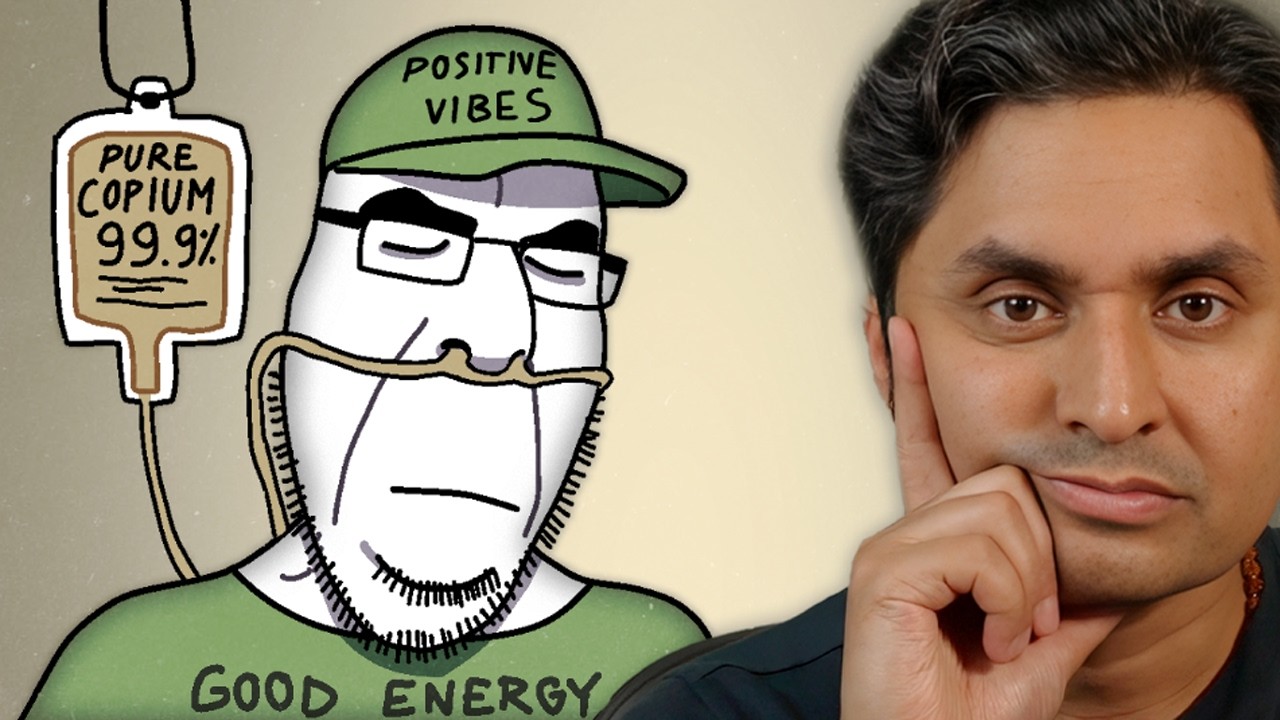
No clickbait detected — the title and thumbnail deliver what they promise.
AI Opinion
The episode’s most compelling argument lies in its clear demonstration that direct thought control is a flawed premise, bolstered by clinical observations of mental health conditions; the psychiatrist’s professional experience lends considerable weight to this point. However, the assertion linking attentional shifting directly to wealth disparity – contrasting “broke” individuals with “billionaires” – requires more rigorous investigation and feels like an oversimplification. Listeners should consider that while environmental shaping can influence thought patterns, attributing success solely to this practice overlooks other significant factors such as privilege and systemic advantages.
Avatars are AI rewrites of the same facts — style changes, not substance.
Summary
The video challenges the popular notion of "positive thinking," arguing that individuals cannot directly control their thoughts, a perspective supported by the speaker’s experience as a psychiatrist and observations of conditions like OCD and depression. While direct thought control is impossible, the ability to shift attention—choosing where to focus mental energy—is presented as a key differentiator between high performers and those who struggle. The video explores how negative thoughts can spiral into debilitating emotional states and emphasizes the importance of proactively shaping one's environment to cultivate desired thinking patterns, similar to tending a garden. Ultimately, successful individuals view negative thoughts not as roadblocks but as challenges, responding by shifting focus toward solutions, while also recognizing and overcoming tendencies to reject advice due to perceived limitations.
Avatars are AI rewrites of the same facts — style changes, not substance.
Key Points
The Core Argument: You Can't Control Your Thoughts
The speaker directly challenges the common belief that individuals can control their thoughts, citing disagreement with figures like Eileen Guo and Louis House. This central argument forms the foundation of the discussion, contrasting popular self-help narratives with a more nuanced understanding of how the mind operates. The speaker's professional experience as a psychiatrist reinforces this viewpoint, suggesting it’s a fundamental truth often obscured by motivational rhetoric.
OCD and Depression: Examples of Uncontrollable Thought Patterns
The speaker uses examples of Obsessive-Compulsive Disorder (OCD) and depression to illustrate the inability to control thoughts. In OCD, individuals experience intrusive thoughts they cannot suppress, while those experiencing depression grapple with persistent negative thought patterns. These cases demonstrate that even highly successful people can be subject to uncontrollable mental processes, regardless of their efforts to think positively.
The Power of Shifting Attention
While direct thought control is impossible, the speaker emphasizes the crucial ability to shift attention away from unproductive thoughts. This skill separates high performers and billionaires from those who struggle. The analogy of changing TV channels highlights that individuals can choose where they focus their mental energy, effectively redirecting their cognitive resources.
Thought Spirals: A Negative Feedback Loop
The speaker explains the concept of 'thought spirals,' a detrimental pattern where one negative thought triggers another, leading to increasingly pessimistic conclusions. The example of someone being dumped and spiraling into feelings of unlovability illustrates how unchecked thoughts can escalate into debilitating emotional states. Recognizing this spiral is key to interrupting it by shifting attention.
The Importance of a Controlled Environment for Thinking
Highly successful people actively control their environments to induce specific types of thinking, contrasting with those who don't consciously shape their surroundings. This involves minimizing exposure to negative influences and maximizing opportunities for positive reinforcement, such as having a coach or access to resources like an infrared sauna. The analogy of a garden is used to illustrate how deliberate actions can cultivate desired mental states.
The Garden Analogy: Cultivating Growth Requires Daily 'Weeding'
Just as a gardener plants seeds and fertilizes, we take action to cultivate growth in our minds. However, the crucial element is consistent 'weeding' – removing negative thoughts and influences. This isn’t about eliminating negativity entirely, but rather continuously addressing it through conscious effort and redirection.
The Key Difference: How High Performers Respond to Obstacles
High performers view negative thoughts not as insurmountable obstacles, but as challenges to be overcome. Their immediate response is to shift their focus towards finding solutions and adapting strategies. This contrasts with the mindset of low performers who perceive negativity as a reason for inaction or self-limitation.
Overcoming Resistance: Recognizing and Shifting Negative Reactions
A common barrier to adopting new strategies is the tendency to find reasons why they won’t work, often rooted in perceived disadvantages or differences. Dr. K encourages listeners to observe their own mental reactions when presented with advice and actively shift towards a mindset of application rather than rejection.
Chapters
Claims & Fact Check
People who are incredibly successful believe they can control their thinking.
My job as a psychiatrist is to help people shape their thinking in the correct way.
You can't control what pops into your head.
The ability to shift their attention away from something separates people who are like broke from people who are billionaires.
Highly successful people control their environment to induce specific thinking.
The difference between high and low performers is how they respond to negative thoughts.
People often reject advice because they find reasons why it won't work for them.
Was this digest good?
More from HealthyGamerGG

Digest any single YouTube video — free.
3 free digests — no card, no sign-up wall.
Or just swap the domain of any YouTube link → instant digest