Clickbait Checker
The video title says:
"Essentials: Sleep Toolkit for Optimizing Sleep & Sleep-Wake Timing"
Reality:
The title accurately reflects the episode's focus on practical tools and strategies for improving sleep through circadian rhythm optimization, light exposure, and exercise timing.
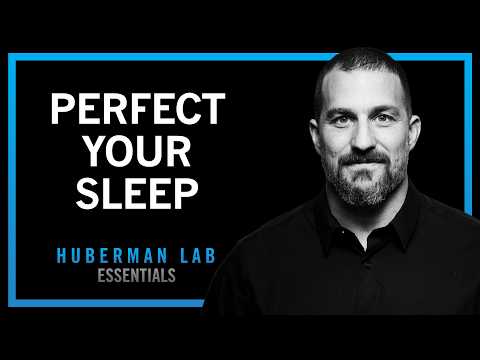
The thumbnail says:
"PERFECT YOUR SLEEP HUBERMAN LAB ESSENTIALS"
Reality:
While the thumbnail highlights 'perfecting' sleep, the episode provides specific, nuanced advice rather than a guaranteed perfect solution; it’s more about understanding and manipulating factors influencing sleep.
AI Opinion
The episode effectively conveys the importance of morning sunlight for regulating circadian rhythm and offers a practical framework for understanding how timing influences sleep patterns, particularly concerning exercise and stimulants relative to an individual’s temperature minimum. However, claims regarding cortisol release triggered by morning light and the precise timing of one's temperature minimum lack robust scientific backing presented within the episode; these are often individualized and may vary significantly. Listeners should approach the advice on caffeine restriction and nap duration with caution, recognizing that optimal strategies depend heavily on personal physiology and lifestyle factors, rather than universal guidelines. It’s worthwhile to research individual variations in circadian rhythm markers and consult healthcare professionals for personalized sleep optimization plans.
Voices are AI rewrites of the same facts — style changes, not substance.
Summary
This episode focuses on optimizing sleep and circadian rhythm through strategic light exposure, exercise timing, and understanding individual biological markers. Morning sunlight is crucial for triggering cortisol release and setting the body's internal clock; artificial light lacks this effect. Exposure to bright light early in the day promotes wakefulness while minimizing evening light exposure helps maintain healthy sleep patterns. The episode highlights three key periods within a 24-hour cycle impacting sleep, emphasizing that intense exercise or caffeine near one’s temperature minimum (roughly two hours before waking) can delay the circadian rhythm, whereas engaging with these stimuli after this point advances it. Understanding and manipulating your temperature minimum can also be used to adjust to new time zones. The advice provided includes limiting late-day naps and caffeine intake, and generally prioritizing bright light exposure in the morning and afternoon.
Voices are AI rewrites of the same facts — style changes, not substance.
Key Points
Morning Light Triggers Cortisol Release
Exposure to bright light, ideally sunlight, within the first 60 minutes of waking triggers cortisol release and sets a timer for sleep later.
Melanopsin Cells & Superchiasmatic Nucleus
Intrinsically photosensitive melanopsin cells in the eye signal to the superchiasmatic nucleus, triggering cortisol release and wakefulness.
Sunlight Viewing Best Practices
Look *towards* the sun (not directly at it) without sunglasses for optimal benefit. Corrective lenses can enhance this effect.
Artificial Light Limitations
Artificial light is insufficient to trigger cortisol release in the morning, unlike sunlight.
Asymmetry of Light Exposure
Bright light early in the day is beneficial for wakefulness and sleep; even small amounts of artificial light at night can disrupt circadian rhythms.
Three Critical Periods for Sleep Optimization
The speaker outlines three critical periods within a 24-hour cycle that significantly impact sleep quality and wakefulness.
Exercise Timing Impacts Circadian Rhythm
Intense exercise in the afternoon or evening can delay the circadian clock and shift sleep timing later.
Importance of Afternoon Sunlight Exposure
Getting sunlight in the afternoon helps inoculate the nervous system against negative effects of artificial light at night, signaling evening time to the body.
Temperature Minimum Definition
Your temperature minimum is a time (approximately 2 hours before your typical wake-up time) when your body reaches its lowest temperature in the 24-hour cycle.
Impact of Stimuli on Clock Timing
Exposure to bright light, exercise, or caffeine near your temperature minimum delays your circadian rhythm, making you want to sleep and wake up later. Conversely, these activities after the minimum advance your clock.
Using Temperature Minimum for Travel Adjustment
You can strategically use light exposure, caffeine, or exercise before travel to shift your body clock towards the destination's time zone.
Chapters
Claims & Fact Check
Morning sunlight exposure triggers cortisol release.
?UnverifiedArtificial lights are not sufficient to replace morning sunlight for triggering wakefulness.
±Partially supportedNapping is fine, but avoid late or long naps.
±Partially supportedLimit caffeine intake after 4 p.m.
?UnverifiedYour temperature minimum is approximately 2 hours before your typical wake up time.
?UnverifiedExposure to bright light, exercise or caffeine near your temperature minimum will delay your clock.
±Partially supportedMore from Huberman Lab
The Science & Treatment of Bipolar Disorder | Huberman Lab Essentials
Jul 16, 2026
How to Improve Your Memory & Cognitive Function at Any Age | Dr. Alan Castel
Jul 13, 2026
The Science & Treatment of Obsessive Compulsive Disorder (OCD) | Huberman Lab Essentials
Jul 9, 2026
Raising a Dog & Mastering Calm Assertive Energy | Cesar Millan
Jul 6, 2026