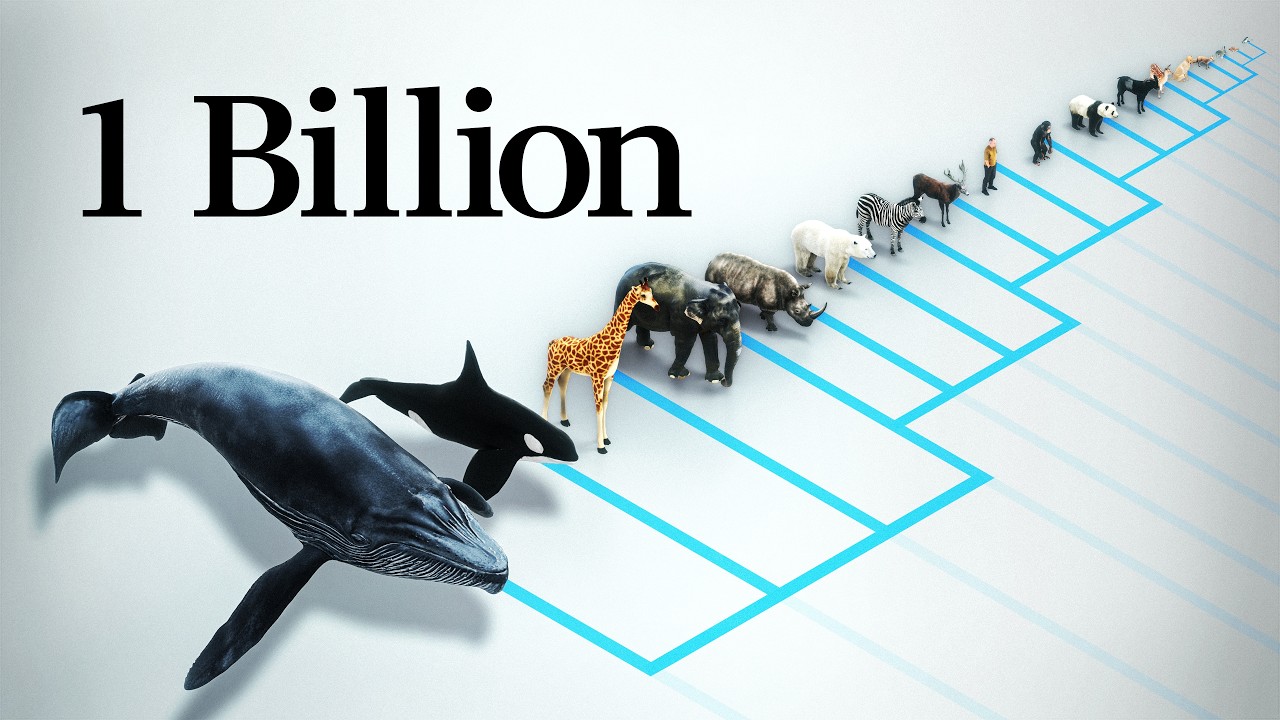
No clickbait detected — the title and thumbnail deliver what they promise.
AI Opinion
The episode most convincingly demonstrates how metabolic rate and surface area-to-volume ratios contribute to a surprising consistency in mammalian lifespans, linking these factors to established principles like Kleiber’s Law—a compelling explanation for an initially puzzling observation. However, the anecdote regarding the Tusko elephant experiment, while illustrative, leans heavily on historical accounts with limited verifiable detail, and the claim that LSD dosage should be directly proportional to mass requires more nuanced consideration of individual metabolic differences. Listeners should investigate the ongoing debates surrounding Kleiber’s Law itself, as well as the potential for variations in scaling exponents across different mammalian species and ecological contexts; the episode rightly acknowledges these complexities but doesn't fully explore them.
Avatars are AI rewrites of the same facts — style changes, not substance.
Summary
The episode explores the surprising consistency in mammalian lifespans, specifically that mammals from tiny shrews to massive elephants tend to have around one billion heartbeats throughout their lives. This observation challenges simple expectations based on size and longevity and is linked to fundamental scaling laws governing physiology. A historical anecdote about a fatal LSD experiment on an elephant highlights the dangers of assuming linear relationships in biological systems, particularly regarding drug dosage. The episode delves into metabolic rate, surface area-to-volume ratios, and how these factors influence heat dissipation and blood flow efficiency – explaining why larger animals require increased metabolic activity to avoid overheating. Mathematical concepts like Hausdorff dimension are introduced to explain efficient surface area packing within the circulatory system, ultimately connecting to West, Brown, and Enquist's theory and Kleiber’s Law regarding the relationship between mass, metabolic rate, and heart rate. The episode concludes by acknowledging ongoing debates surrounding Kleiber’s Law and emphasizing the importance of rigorous data collection to refine our understanding of these universal biological scaling principles.
Avatars are AI rewrites of the same facts — style changes, not substance.
Key Points
The Tusko LSD Experiment's Fatal Flaw
In the 1960s, as part of the CIA’s MKUltra project, researchers attempted to administer LSD to an Indian elephant named Tusko at the Lincoln Park Zoo. They mistakenly assumed that drug dosage should scale linearly with mass and injected him with nearly 300 milligrams. This resulted in a rapid collapse, seizure, and ultimately death, highlighting the error of assuming linear scaling for drug dosages.
The Unexpected Heartbeat Consistency Across Mammals
Remarkably, mammals ranging from the tiny Etruscan shrew to the massive African bush elephant all exhibit a lifespan with approximately one billion heartbeats. This consistent number extends to other mammals like wallabies and sloths, regardless of their size or longevity, challenging conventional expectations about biological scaling.
Metabolic Rate's Influence on Drug Processing
The speed at which an animal processes chemical compounds isn’t directly tied to its mass, but rather to its metabolic rate – the number of calories it uses in a given time. This is because larger animals have more cells and therefore require more energy, leading to increased heat production that must be dissipated through their surface area.
Surface Area vs. Volume: A Crucial Scaling Relationship
When considering the relationship between an animal's size and its ability to regulate temperature, it becomes clear that surface area plays a critical role. While volume (and therefore mass) increases exponentially with radius, surface area only grows quadratically, meaning larger animals face challenges in dissipating heat generated by their increased metabolic rates; otherwise they would ‘boil alive’.
Minimizing Blood Reflection for Efficiency
To optimize blood flow, nature favors designs that minimize reflections within the circulatory system. Reflections occur at branching points in blood vessels and increase the energy required to pump blood. The solution involves maintaining a consistent cross-sectional area of vessels before and after branching; for example, two branches should each have an area of one centimeter squared if the main vessel has an area of two centimeters squared.
Hausdorff Dimension and Surface Area Packing
Mathematician Felix Hausdorff developed a concept to describe self-similar fractals, which are shapes that repeat patterns at different scales. He assigned a 'dimension' to these fractals; a straight line has a dimension of 1.0, while a space-filling fractal curve, like crumpled paper filling a plane, can have a dimension of 2.0, effectively increasing surface area.
WBE Theory and Metabolic Scaling
West, Brown, and Enquist's (WBE) theory explains how an animal’s size affects its metabolic rate. They realized that a fractal-like circulatory system allows for greater surface area packing than expected based on volume alone. This increased surface area enables faster resource exchange, leading to metabolic rates scaling with mass to the three-quarters power – consistent with Kleiber's Law.
Heart Rate Scaling with Mass
The relationship between heart rate and an animal’s mass is directly linked to metabolic rate. Since the volume of blood per heartbeat scales proportionally to mass, and blood flow rate mirrors metabolic rate, heart rate itself must scale as metabolic rate divided by mass. This connection reinforces Kleiber's Law and highlights how fundamental scaling laws govern physiological processes.
Data Analysis and Measurement Challenges
The measurement of metabolic rates is inherently challenging, often requiring animals to be placed in controlled environments with precise measurements of heat production or oxygen consumption. These conditions must ensure the animal is in a low-activity resting state, which is particularly difficult to achieve with larger mammals, leading to significant error bars and complicating data interpretation.
The Debate Surrounding Kleiber's Law Continues
Despite the widespread acceptance of Kleiber’s Law and its three-quarter scaling exponent, significant debate persists within the research community. Some scientists maintain the validity of the original law, while others believe the correct scaling exponent is closer to two-thirds. A growing number of researchers even suspect that a universal scaling exponent may not exist across all life forms.
Potential for Different Scaling Exponents Based on Size
Emerging research suggests that the scaling exponent might not be uniform across all mammals. It's hypothesized that larger mammals may exhibit a three-quarters power relationship between metabolic rate and mass, while smaller mammals could follow a two-thirds power relationship. This nuanced perspective challenges the traditional understanding of Kleiber’s Law.
The Importance of Careful Data Collection
Scientists emphasize the need for meticulous data collection and analysis to resolve the ongoing debate about scaling laws. They advocate for comprehensive measurements, moving beyond limited datasets like a single elephant at one zoo, to ensure more robust and reliable results that can definitively settle the question of metabolic rate scaling.
Chapters
Claims & Fact Check
The CIA conducted a secret project (MKUltra) to explore drug-induced behavior modification.
Administering LSD to an elephant requires a dosage proportional to its mass.
All mammals have roughly one billion heartbeats in their lifetime.
Biological traits can be predicted based on an animal's mass, pulse rate and reproductive output.
Nature favors structures that minimize reflections in blood vessels.
The Hausdorff dimension of the surface of the circulatory system is roughly three.
Heart rate scales as metabolic rate over mass.
Kleiber's Law itself might not be true.
The data does not work [regarding the original symposium vote].
There is no universal scaling exponent across all of life.
Was this digest good?
More from Veritasium




Digest any single YouTube video — free.
3 free digests — no card, no sign-up wall.
Or just swap the domain of any YouTube link → instant digest